
Short of Breath at Work? Understanding COPD, Its Warning Signs, and Workplace Risks
November 18, 2026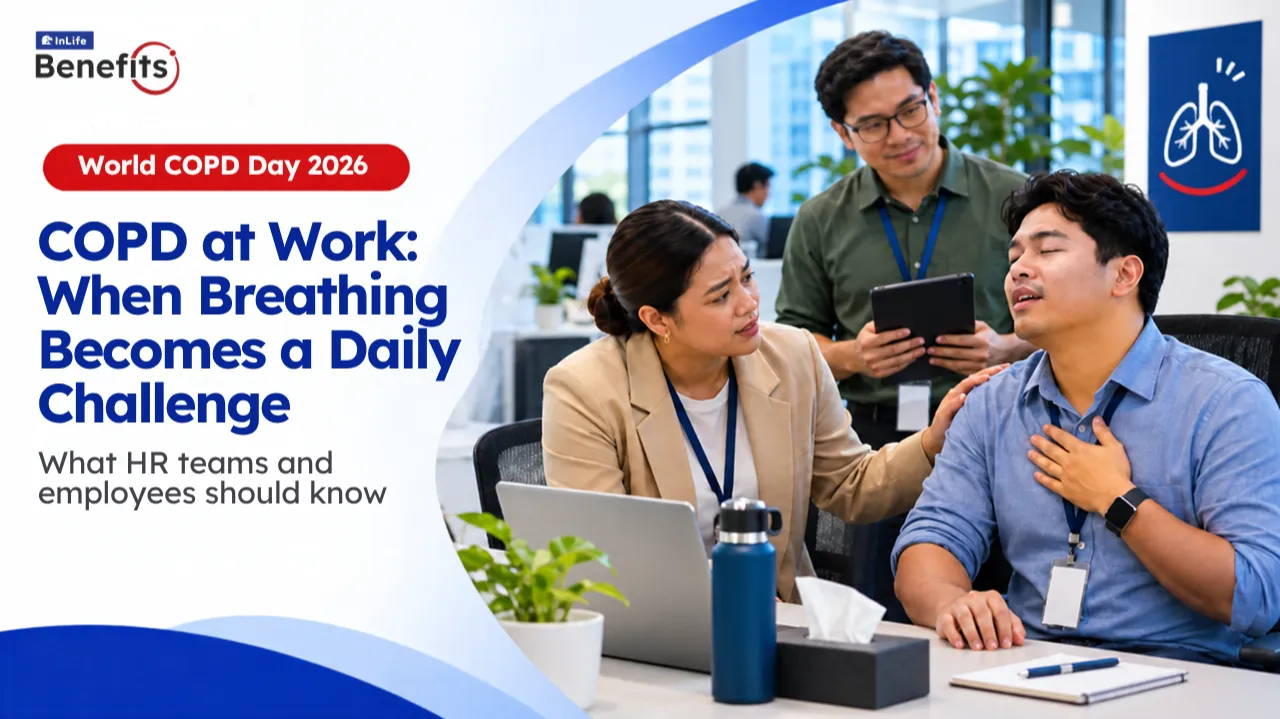
Carlo stops halfway up the stairs to his office. He tells himself he is only tired. But he has been coughing for months, and lately even a short walk leaves him out of breath.
It is easy to dismiss changes like these as stress, age, or poor fitness. Yet a cough that will not go away and frequent breathlessness can be signs of a lung condition that needs medical attention.
Not every workplace has the same risks. A construction worker may breathe in dust. A factory worker may work near fumes. A delivery rider may spend hours in traffic. Office air quality matters too. These exposures do not mean someone will develop COPD, but they make lung health a concern for employers.
This World COPD Day, here is what employees and HR teams should know about chronic obstructive pulmonary disease, or COPD, and how workplaces can help.
What is COPD?

COPD is a long-term lung disease that blocks air flow and makes breathing difficult. It often develops slowly, so a person may not notice the changes at first.
Common signs include:
- A cough that lasts for months
- Frequent mucus or phlegm
- Shortness of breath during normal activities
- Wheezing or a whistling sound while breathing
- Getting tired more easily than before
Smoking is a major risk factor. But people who do not smoke can also develop COPD. Long-term exposure to dust, smoke, polluted air, and chemical fumes may raise the risk.
A 2026 review of 257 studies found a link between exposure to gases, dust, and fumes at work and COPD. Most studies were done outside the Philippines, so their results should not be treated as a measure of risk for Filipino workers. Still, the findings give employers a reason to review workplace exposure.
A lasting cough or shortness of breath does not always mean COPD. Asthma, infections, and other health problems can cause similar symptoms. A doctor needs to assess the cause.
Why early action matters
The theme of World COPD Day 2026 is “Early Diagnosis and Management for a Better Life.” It reminds us that breathing problems deserve attention before they make everyday tasks harder.
A doctor looks at a person's symptoms, health history, and possible exposure to smoke or other pollutants. If COPD is suspected, the doctor may recommend spirometry.
Spirometry is a breathing test. You take a deep breath and blow air out as hard and fast as you can. The test measures how much air you can blow out and how quickly. The doctor also checks breathing after a medicine that opens the airways. These results help confirm lasting air flow blockage.
COPD has no cure, but proper care can help control symptoms and reduce sudden breathing problems. Treatment may include inhalers, help with quitting smoking, pulmonary rehabilitation, and recommended vaccinations.
For Carlo, a medical visit could help explain why stairs and short walks have become more difficult. For HR teams, allowing time for an appointment can help an employee take that first step.
COPD and the Philippine workplace
The risk depends on the type of work, how much dust or pollution is present, and how often people are exposed. An office and an outdoor worksite may need different safety measures. This is why employers should review air-quality risks in each work area instead of assuming that everyone faces the same conditions.
For an employee living with COPD, even normal duties may become tiring. Walking across a large site, lifting items, or working outside can be harder on some days. Breathing problems may affect daily tasks or lead to time away from work for treatment. Others can work as usual. Managers should ask what support an employee needs rather than make assumptions.
In September 2026, the Department of Labor and Employment (DOLE) issued Labor Advisory No. 15, Series of 2026, on protecting workers from poor ambient air quality, such as smoke, haze, and smog. It advises employers to assess air-quality risks and take suitable steps, especially for outdoor work. This is general air-quality guidance, not a COPD-specific regulation.
What can employers do to help?

Doctors handle diagnosis and treatment. Employers can support better lung health by reducing avoidable exposure and making it easier to get medical care.
1. Check the air at work. Ask the occupational safety and health team to review ventilation and possible sources of dust, smoke, and chemical fumes. Act on problems found and keep shared spaces smoke-free.
2. Watch outdoor air conditions. Monitor local air-quality advisories. When the air is unhealthy, review outdoor tasks and follow DOLE's applicable safety guidance. Consider a different schedule or work setup when needed.
3. Make time for medical care. When work allows, offer reasonable time for consultations, treatment, and recovery. Short rest breaks or small changes to tasks may also help some employees.
4. Explain how benefits work. Remind employees how to check their coverage, find accredited providers, request approvals, and ask questions. A benefit is more useful when people know how to access it.
Keep health discussions private. Employees should be able to ask for help without sharing their medical details with the whole team.
What if you notice the signs?
If you have been coughing for months, often feel breathless, or notice that daily tasks are getting harder, speak with a healthcare professional. Tell your doctor about your symptoms and any exposure to dust, smoke, or fumes at home or work.
Do not try to diagnose COPD on your own or wait for a yearly checkup if symptoms continue. If you suddenly have severe trouble breathing, seek emergency medical care.
Carlo does not need to know the name of his condition before asking for help. He only needs to recognize that his breathing has changed.
Making healthcare easier to access
Recognizing symptoms is an important first step. Knowing where to seek medical advice and how to use health benefits can help employees get appropriate care.
For InLife Benefits members, the Member Mobile App provides access to important health benefit information and services.
Through the app, members can:
● View their membership and benefit details
● Find accredited healthcare providers
● Use a virtual member card
● Request a Letter of Authority (LOA)
● Access available doctor consultation services
Available services and coverage depend on each member's plan. Telemedicine is not for emergencies and does not replace an in-person medical exam when one is needed.
Know your benefits. Know where to seek help.
For members: Check your plan and find healthcare support through the InLife Benefits Member Mobile App.
Download on the App Store (iPhone)
Get it on Google Play (Android)
Learn more about the Member Mobile App.
For employers and HR teams: Review how your employees access medical support. You can also learn about InLife Benefits Group Health, an optional rider for eligible group insurance plans, and request a proposal on the official website.
Small workplace changes and clear benefit information can help employees seek care earlier and manage their health while working.
References
Arrandale, V. H., et al. (June 24, 2026; updated after July 27 correction). Vapors, gases, dusts and fumes at work and chronic obstructive pulmonary disease/bronchitis: A systematic review and meta-analyses. Journal of Occupational Medicine and Toxicology.
Arrandale, V. H., et al. (July 27, 2026). Correction to the 2026 occupational exposure review: Three table references were reversed. The published article has been updated.
Department of Labor and Employment, Bureau of Working Conditions. (September 21, 2026). DOLE steps up worker protection amid poor air quality. Labor Advisory No. 15, Series of 2026.
Global Initiative for Chronic Obstructive Lung Disease. (2026). GOLD 2026 Report and Pocket Guide.
Global Initiative for Chronic Obstructive Lung Disease. (2026). World COPD Day 2026.
InLife Benefits. Member Mobile App and Group Health.
Medical disclaimer: This article offers general health information and does not replace medical advice, diagnosis, or treatment. Carlo is an illustrative example, not an actual patient. Health benefits and services depend on plan terms.
Read our other blog posts.
Short of Breath at Work? Understanding COPD, Its Warning Signs, and Workplace Risks
November 18, 2026
How to Support an Employee Who Is Struggling With Their Mental Health
October 10, 2026

The Checkup We Keep Putting Off: Why Breast Health Shouldn't Wait
October 2, 2026

One Disease, Many Hands: Why Rabies Prevention Is Stronger Together
September 28, 2026